Hair Care Routine for Men With Daily and Weekly Steps That Actually Work
A good hair care routine for men should make your hair easier to manage, not turn every morning into a complicated grooming project. The goal is not to use as many products as possible. It is to understand how your scalp, hair texture, haircut, and styling habits work together so you know when to cleanse, when to condition, when to style, and when to leave the hair alone.
Many men build their routine around one question: “What product should I buy?” A better starting point is to look at what your hair actually does during the day. Does it become oily quickly? Does the top fall flat after a few hours? Do the ends feel dry while the scalp feels greasy? Does your hairstyle only work when you use a large amount of product?
At Old Fashioned Barbershop, we see hair care as part of maintaining the haircut itself. A well-cut hairstyle gives you the structure, but your daily habits decide whether that structure remains easy to recreate between appointments. This guide builds a practical hair care routine for men around daily maintenance, weekly resets, styling choices, and the way your hair actually behaves.
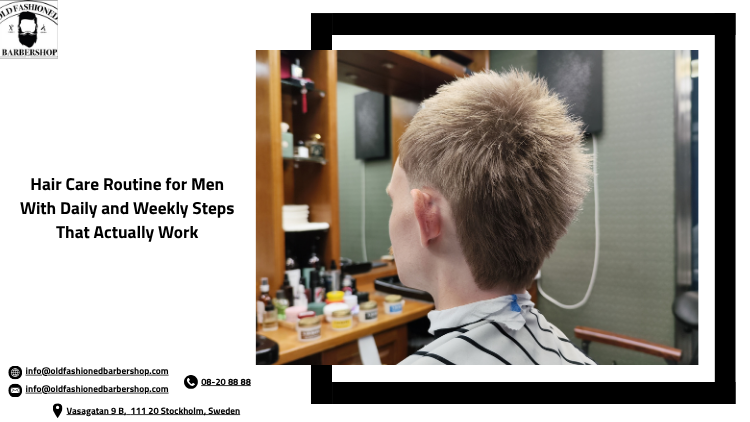
How to Build a Hair Care Routine for Men That Actually Works
Most men do not need an extremely long list of grooming steps. They need a routine that keeps three areas under control: the scalp, the hair itself, and the final hairstyle.
The scalp is where oil, sweat, and product residue accumulate. If it becomes excessively greasy or loaded with old styling product, the hair can lose volume and begin to separate. The hair lengths have a different problem. They can become dry, rough or difficult to control even when the scalp itself feels oily.
Styling is the third layer. It should shape hair that is already in good condition rather than compensate for problems caused by poor washing, excessive product buildup, or an overgrown haircut.
Once you separate these three jobs, building a hair care routine for men becomes much easier. You can choose each step because it solves a specific problem instead of using products simply because they are marketed as part of a grooming routine.
Your morning routine should begin by checking the hair, not washing it automatically
Many men wash their hair every morning because it feels like the natural starting point of grooming. That does not mean every morning needs a complete shampoo routine.
Start by looking at the scalp and touching the hair. If it still feels clean, holds some natural movement and has no heavy product buildup, you may only need to reshape it. A little water, controlled blow-drying, or a small amount of styling product may be enough.
If the roots feel oily, the hair has absorbed a lot of sweat, or yesterday's styling product is still coating the strands, a proper wash may make more sense.
This simple check keeps you from treating every day exactly the same. A useful routine responds to the condition of your hair instead of following a fixed calendar regardless of what the scalp actually needs.
Wash the scalp properly instead of scrubbing the whole head
When shampoo is needed, concentrate most of the cleansing around the scalp and roots where oil and buildup are strongest. You do not need to aggressively scrub the entire length of the hair to make it clean.
Work the shampoo into the scalp with controlled fingertip movements and allow the foam to move through the rest of the hair during rinsing. The purpose is to remove excess oil and styling residue without turning washing into another source of unnecessary friction.
The amount of shampoo also matters. Using more does not automatically create cleaner hair. If you constantly need a large amount to remove yesterday's styling, the bigger issue may be how much product is being used during the week.
A balanced hair care routine for men should leave the scalp refreshed while the hair still feels manageable after drying.
Conditioning should match your hair length and texture
Conditioner becomes more useful as hair gains length, texture, or dryness. A very short haircut may need relatively little, while medium-length, wavy, curly or coarse hair can benefit more noticeably from the extra manageability.
Where you place conditioner also matters. If you have fine hair that becomes flat easily, concentrate it mainly through the lengths instead of heavily coating the roots. Thicker, drier, or curlier hair may tolerate more conditioning.
The purpose is not to make the hair feel coated or extremely soft. It is to reduce unnecessary roughness and make the hair easier to comb, dry, and style.
If your hair always collapses immediately after conditioning, you may be using too much or using a formula that is too heavy for your hair type.
Drying is where the hairstyle begins to take shape
The haircut does not suddenly become styled when the pomade or clay is applied. Shape begins during drying.
If you want more volume, direct the hair upward or away from the scalp while blow-drying. If you wear a side part, establish the direction while the hair is still slightly damp. If your haircut is textured forward, start guiding the front before the hair becomes completely dry.
This reduces the amount of work the finishing product needs to do later.
Avoid automatically using the hottest setting. Controlled airflow and moderate heat are usually enough to create direction. The closer your hair already is to the final shape after drying, the less styling product you normally need.
This principle is one of the easiest ways to make a hair care routine for men faster without sacrificing the final result.
Choose styling product based on the finish, not the packaging
The category of product matters more than the design of the jar.
Before choosing between different men’s hair styling products, decide what you want the hair to look like. Do you need matte texture, natural movement, stronger definition, a polished finish, or additional hold?
A textured crop usually needs a different type of product from a slick back. Fine hair may need lighter styling than thick hair. A flexible side part does not need the same level of control as a structured pompadour.
Once the target is clear, comparing products becomes much easier.
The mistake is choosing a strong product simply because stronger sounds better. Excessive hold can make some hairstyles rigid, while heavy formulas can pull fine hair down and reduce natural volume.
Use less product first and build from there
A large amount of product makes mistakes harder to correct.
Begin with a small quantity, spread it thoroughly between your hands and distribute it through the hair before adding more. This helps prevent all the product from collecting around the front or on the surface.
For most styles, building in stages gives you more control than beginning with the maximum amount.
If your hairstyle requires a large quantity every morning just to stay in place, consider whether the product is wrong for your hair or whether the haircut itself has grown out of shape.
Good styling should support the haircut rather than fight it.
What to do with your hair at the end of the day
Hair care does not stop once the morning styling is finished.
At the end of the day, consider what is still sitting in the hair. If you used a light product and the scalp still feels comfortable, you may not need to do anything special. If the hair contains a heavy layer of wax, pomade, spray, or dry styling product, leaving that buildup repeatedly can make the next morning more difficult.
You do not necessarily need shampoo every night. The point is to avoid continuously adding new styling over old layers for several days.
A useful hair care routine for men keeps the hair from gradually becoming heavier through the week. When buildup becomes noticeable, reset it properly rather than trying to disguise it with another product.
The Weekly Reset in a Hair Care Routine for Men
One of the most useful weekly habits is giving the hair a cleaner starting point.
If you use styling products regularly, choose a wash during the week when you pay more attention to removing residue from the scalp and roots. This does not mean using extremely aggressive shampoo. It means taking enough time to cleanse properly rather than doing a rushed wash and immediately adding more product.
Afterward, condition according to your hair type and allow the hair to dry with minimal styling if your schedule allows it.
This gives you a chance to see how the hair behaves without several layers of product influencing the result.
Your weekly reset is also a good time to notice whether the haircut is becoming more difficult to control. If the sides are getting heavy or the top no longer sits correctly after washing and drying, the issue may be the haircut rather than your routine.
Fine hair needs weight control more than extra product
Fine hair often becomes difficult when too many heavy products are added.
If the roots collapse quickly, concentrate on keeping them clean enough to maintain movement. Use conditioner carefully and avoid saturating the hair with oils or heavy styling creams if they consistently reduce volume.
Drying becomes particularly important here. Building shape with airflow before applying product can create lift without forcing the hair to carry additional weight.
When comparing Firsthand Hair Care products or other grooming ranges, focus on function. A lighter product that creates texture and control may be more useful than a richer formula simply because the latter feels more premium.
The right routine for fine hair usually feels simple because each product has to justify the weight it adds.
Thick hair needs control without turning into a helmet
Thick hair creates a different challenge. It can hold strong shapes, but excessive bulk can make everyday styling difficult.
Conditioning can improve manageability, particularly once the top becomes longer. At the same time, the haircut needs to remove weight in the correct places. No amount of styling product can permanently compensate for a shape that has become too heavy.
For men who need strong control, Uppercut Hair Products may be relevant to compare depending on the desired finish and level of hold. The important point is still to match the product with the hairstyle rather than assuming thick hair always needs the strongest formula available.
A successful routine keeps thick hair controlled while preserving enough movement that the hairstyle still looks natural.
Wavy hair should keep some of its natural movement
Wavy hair can create excellent volume when it is not overloaded.
Over-brushing, excessive product, or attempting to make every section perfectly straight can remove the movement that makes the texture visually interesting.
After washing, guide the hair in a general direction without trying to eliminate every wave. Depending on the haircut, a small amount of flexible product may be enough to define the shape.
When the hair becomes too dry, the waves can look rough and difficult to control. When it becomes too heavily conditioned, they may lose structure.
The best routine sits between those two extremes.
Curly hair needs consistency more than constant manipulation
Curly hair often performs better when the routine is predictable.
Repeatedly brushing or reshaping dry curls can break the pattern and create a less controlled finish. It is often easier to establish the form while the hair still contains some moisture and then allow the curls to settle.
Moisture and conditioning generally play a larger role here than they do with very short straight hair.
At the same time, do not assume every product labelled for curls must become part of your routine. Add products only when they solve a visible problem such as dryness, poor definition or difficult manageability.
A strong hair care routine for men with curly hair should help the natural texture remain consistent from day to day.
Longer hair changes the entire routine
As men's hair grows, habits that worked for a short crop may stop being effective.
Longer hair has more length to dry, condition, and protect from unnecessary friction. Product needs may also change. A strong wax designed for a short textured style can become impractical once the hair reaches medium length and needs more movement.
You may also need to spend more time distributing conditioner through the lengths rather than treating the whole head as one section.
For longer hairstyles, the weekly condition of the hair becomes more noticeable. Dry ends, product buildup, and inconsistent washing can affect the final style much more than they do with a very short cut.
Separate pre-styling from finishing products
Not every styling product needs to do everything.
A pre-styling product can help create volume, direction, or texture before the final product is used. A finishing product provides the hold, separation, or shine that determines how the style looks.
This distinction is useful when comparing Layrite Hair Products or other styling ranges because products with different finishes may have completely different roles in the routine.
For example, you may create the shape with blow-drying and then use a small amount of finishing product only where extra control is needed.
This method often looks more natural than applying a large amount of one product and expecting it to create volume, direction, and final hold simultaneously.
Your styling routine should change between workdays and relaxed days
You do not need the same finish every day.
A structured workday may call for a cleaner definition and a more reliable hold. A relaxed weekend may only need some direction and light texture.
Using less product on days when you do not need a highly controlled finish can also make the weekly routine easier. There is less residue to remove, and the hair has more opportunities to move naturally.
If you use Noberu grooming product options as part of your routine, think about which days actually require stronger grooming and which days can remain lighter.
A routine becomes more sustainable when it adapts to your schedule instead of treating every morning as a formal styling session.
Hair products should solve different problems
Using three products that perform almost the same job does not make the routine more advanced.
One product might improve manageability after washing. Another may create texture during styling. A third may provide a stronger hold on specific days.
That logic matters more than the number of brands in the bathroom.
When comparing Bazgir & Veljkovic products, for example, look at where an individual product would fit into your existing routine rather than adding it simply because it belongs to a grooming range.
Ask one question before adding anything new: what problem will this product solve that my current routine does not?
If there is no clear answer, you may not need it.
Grooming products should match your haircut
A short crop, classic side part, pompadour, and longer textured hairstyle all require different approaches.
This is why broad collections such as Depot men’s grooming products should be considered according to the haircut rather than the brand name alone.
A short crop may need texture and moderate hold. A classic side part may benefit from smoother control and a more polished finish. A longer style may need pre-styling and lighter finishing products so that movement is preserved.
The product should extend the logic of the haircut.
If the haircut is designed for natural movement but your product freezes it into a hard shape, the two are working against each other.
Stockholm weather and daily routine can change how hair behaves
Your environment matters more than most men realise.
Indoor heating, cold weather, humidity, rain and wearing hats can all change how the hair feels and styles throughout the day. A routine that works perfectly during one season may need minor adjustments during another.
This does not mean replacing every product several times per year.
It may simply mean reducing the amount of styling when the hair becomes drier, conditioning slightly differently, or changing how much hold you use on humid days.
When shopping for hair products Stockholm, think about your actual routine and environment rather than copying a product list created for someone with different hair and different daily conditions.
Wash after training based on sweat and buildup, not guilt
Exercise often makes men feel that shampoo is automatically required.
If the scalp is heavily sweaty and the hair contains styling product, a proper wash may be the most comfortable option. If the training session was light and the hair still feels manageable, you may not always need a complete shampoo routine.
The important part is avoiding buildup over several sessions.
If you exercise regularly, you may also benefit from using less styling product before training when possible. That makes the scalp easier to clean afterward and prevents heavy mixtures of sweat and product from accumulating around the roots.
Your hair care routine for men should fit your training schedule instead of making hair care feel like a separate full-time job.
Do not judge a product after one use
Hair products often behave differently depending on how much you use, how dry the hair is, and whether you apply them before or after blow-drying.
Before deciding that a product does not work, test it with different amounts and application methods.
You may discover that a clay that felt heavy in damp hair creates excellent texture when applied lightly to fully dry hair. A cream that seemed ineffective alone may work better as a pre-styler.
This is particularly relevant with men’s hair styling products, where the same formula can produce very different results depending on technique.
Change one variable at a time so you know what actually improved or weakened the result.
Know when the problem is the haircut instead of the routine
One of the biggest mistakes men make is trying to fix an overgrown haircut with more product.
If the sides have become bulky, the top has lost structure, or the fringe no longer sits correctly, adding stronger product may only make the hair heavier.
Pay attention to whether the routine worked perfectly a few weeks ago using the same products. If the answer is yes, the changing haircut may be the reason styling has become more difficult.
A good barber visit resets the proportions.
That is why grooming products and haircut maintenance should be planned together rather than treated as completely separate parts of your appearance.
Use your barber appointment to improve your home routine
A barber appointment is one of the best opportunities to understand how your hair should be managed.
Watch how the hair is dried after the cut. Notice the direction of the airflow, where volume is created, and how much product is actually used.
Ask why a particular type of styling product suits the haircut.
This information is often more useful than simply buying the same jar. Understanding the technique allows you to recreate the result even if you later change products.
At Old Fashioned Barbershop, the haircut should make your hair care routine for men easier, not create a style that only works immediately after leaving the chair.
Five signs your routine has become unnecessarily complicated
A routine can gradually become overloaded without you noticing.
You need several products to make the haircut look normal.If every morning requires layering multiple products just to make the hair behave, the haircut or product selection may need to be simplified.
The hair feels heavy by the middle of the day.This can indicate too much styling product, overly rich conditioning, or incomplete cleansing between styling days.
You constantly change products without changing technique.Different products cannot fix poor application, excessive amounts, or a haircut that has lost shape.
You wash because the routine tells you to, not because the hair needs it.Your scalp, activity level, and product use should influence wash frequency more than an arbitrary schedule.
You cannot explain what each product actually does.If two or three products serve almost the same purpose, removing one may make the routine easier without affecting the result.
A good hair care routine for men should become more predictable over time, not more complicated.
Build a simple daily routine you can repeat
Your daily routine can be straightforward.
In the morning, check whether the hair actually needs washing. If it does, cleanse the scalp properly and condition according to your hair type. Dry the hair in the direction of the final hairstyle and apply a small amount of the product that matches the required finish.
During the day, avoid constantly adding more product every time the hairstyle moves slightly. Most styles should retain some natural flexibility.
At night, check whether heavy product buildup needs to be removed or whether the hair can simply be left alone until the next morning.
Consistency makes it easier to identify what your hair responds to.
Give the week a rhythm rather than a rigid schedule
A weekly routine should not mean shampoo on specific days regardless of what happens.
Instead, think of the week in terms of different needs.
Some days are full wash and reset days. Others are light styling days. Training or social events may require additional washing or stronger styling. Relaxed days are opportunities to use less product and see how the haircut behaves naturally.
Once during the week, pay particular attention to buildup and the condition of the scalp. If the hair feels increasingly heavy even immediately after washing, reassess the amount and type of products you use.
A flexible hair care routine for men is usually more sustainable than a seven-day timetable that ignores real life.
How to Know Your Hair Care Routine for Men Is Working
The easiest way to judge whether your routine works is not the number of products you own.
Ask whether the hair is easier to style than it was a month ago. Does it require less product? Does the scalp feel comfortable? Does the haircut keep its shape between appointments? Can you recreate the barber's result without spending half an hour in front of the mirror?
If the answer is yes, the routine is doing its job.
If not, simplify it and identify the weakest part. Sometimes the answer is better cleansing. Sometimes it is lighter styling. Sometimes the haircut itself needs to change.
Build your routine around your haircut at Old Fashioned Barbershop
The best products cannot completely compensate for a haircut that does not work with your texture, density, or daily routine.
At Old Fashioned Barbershop, the goal is to create a haircut that remains practical after you leave the chair. That means considering how the hair grows, how much time you want to spend styling it, and what type of finish fits your personal style.
A strong hair care routine for men then becomes much easier to maintain because the haircut already provides the right structure.
Book your next haircut at Old Fashioned Barbershop and get a style that works with your hair, your grooming habits, and the amount of time you actually want to spend on your routine each day.
Frequently asked questions about a hair care routine for men
1. What should a basic hair care routine for men include?
A basic routine should cover cleansing when needed, conditioning according to hair type, proper drying, and styling with a product that matches the haircut. The exact frequency of each step depends on the scalp, hair texture, and product use.
2. Should men shampoo their hair every day?
Not every man needs daily shampoo. Wash frequency should depend on oil production, sweat, product buildup, and how the hair feels rather than automatically shampooing every morning.
3. Do men really need conditioner?
Conditioner can be useful when the hair has enough length to become dry, rough, or difficult to manage. Fine hair may need a lighter application, while thicker, curly, or drier hair may benefit from more conditioning.
4. When should styling product be applied?
It depends on the product and hairstyle. Some products can be used in slightly damp hair for control, while others create stronger texture or definition when applied after the hair is completely dry.
5. How much styling product should men use?
Start with a small amount and add more only if needed. Using too much from the beginning can make the hair heavy and reduce natural movement.
6. How can men make fine hair look fuller?
Keep heavy products to a minimum, create shape during blow-drying, and use a lightweight styling product that provides texture without weighing the hair down. The haircut itself also plays a major role.
7. Should styling product be washed out every night?
Not necessarily. Light product may not require a full shampoo every evening, but heavy buildup should not be repeatedly layered with new product over several days.
8. How often should men change hair products?
Change products when your current option no longer solves the problem you need it to solve. Do not switch simply because a new product is popular. Technique and haircut should also be evaluated before replacing a product that previously worked.
9. Can a barber help create a better hair care routine?
Yes. A barber can evaluate your texture, density, and haircut and show how the hair should be dried and styled at home. This can make product selection and daily maintenance much easier.
10. How do I know if my routine is working?
Your hair should become predictable and easier to manage. The scalp should feel comfortable, styling should require a reasonable amount of product, and the haircut should remain easy to recreate between barber visits.
