Choosing a men’s haircut is not only about deciding how short you want your hair. The barber’s cutting technique can influence the texture, shape, movement, maintenance, and overall character of the finished style.
One of the most common decisions is Scissor Cut Vs Clipper Cut. Both techniques can produce excellent results, but they are designed for different hair lengths, hair types, and styling goals. Scissors generally offer greater control over movement, layering, and softness, while clippers are highly effective for creating short, consistent lengths and sharp transitions.
The right choice depends on your hair length, hair texture, density, face shape, preferred finish, and daily styling routine. A client with thick, wavy hair who wants natural movement may need a different approach from someone looking for a very short fade with clean lines.
In many cases, the best haircut does not use only one tool. Professional barbers regularly combine scissors and clippers to control different areas of the head and create a balanced result.
When visiting a professional Barber shop in Stockholm, a barber should assess your hair type, growth pattern, preferred style, and maintenance routine before deciding which tools and techniques to use.
This guide explains the difference between a scissor cut and a clipper cut, the advantages of each technique, and how a professional barber decides which method is more suitable for your hair.
What Is a Scissor Cut?
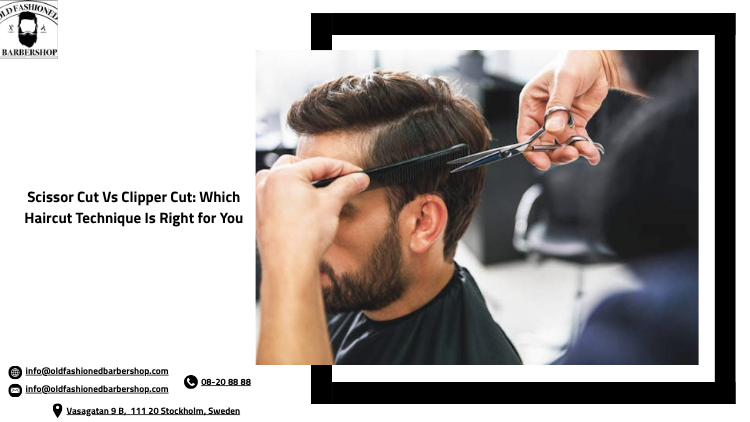
A scissor cut is created mainly with professional haircutting scissors rather than relying on electric clippers to establish the overall length.
The barber separates the hair into controlled sections and gradually removes length. This method allows the barber to see how the hair moves, falls, and connects from one area to another.
A scissor cut for men is particularly useful for medium-length and longer hairstyles. It can also be used on shorter hair when the client wants a softer outline or greater control over the final shape.
Because scissors selectively remove hair, the barber can preserve length in some areas while reducing weight in others. This makes the technique suitable for creating layers, adding texture, controlling thick hair, and improving the natural balance of the haircut.
Scissor work can produce either a structured or relaxed appearance. A classic side part may require precise scissor cutting to create a controlled silhouette, while a longer textured style may use point cutting or layering to encourage movement.
The final result often feels softer than a haircut created entirely with clippers. The transition between lengths can appear more natural, and the hair may grow out without developing an obvious line between shorter and longer sections.
However, the quality of the result depends heavily on the barber’s sectioning, tension, hand position, and understanding of how the hair will behave once it is dry.
What Is a Clipper Cut?
A clipper cut is created primarily with electric clippers and different guard lengths. Each guard controls how much hair remains, allowing the barber to establish short and consistent lengths efficiently.
A clipper cut for men is commonly used for buzz cuts, crew cuts, fades, tapers, and other hairstyles that require short sides or a clearly defined shape.
Clippers are highly effective when the desired length is too short to control comfortably with fingers and scissors. They can remove bulk quickly and create even coverage across larger areas of the head.
The barber may use several guard lengths to create a gradual transition. For example, a fade may begin with an extremely short length near the neckline and become progressively longer toward the upper sides.
Professional clipper cutting involves much more than moving one guard over the entire head. The barber must understand head shape, pressure, direction, lever position, and how to remove visible lines between lengths.
When used correctly, clippers create a clean finish with sharp lines and clear structure. When used without sufficient control, they may leave uneven patches, heavy transitions, or a shape that does not suit the client’s head.
Clipper work is not limited to very short military-style cuts. It can form the foundation of a wide range of modern and traditional men’s hairstyles.
Scissor Cut Vs Clipper Cut: The Main Differences
The main differences between scissor cuts and clipper cuts are the level of control, the suitable hair length, and the type of finish each technique creates.
A scissor cut is generally more suitable for medium-length and long hair. It gives the barber greater control over layers, weight, texture, and natural movement. The final result is usually softer, more flexible, and less sharply defined than a clipper-based haircut.
A clipper cut is more suitable for very short to medium-length hair. It is commonly used for fades, buzz cuts, crew cuts, tapers, and other styles that require consistent short lengths and sharp lines. Clippers allow the barber to create a clean and structured result efficiently.
For thick, wavy, or curly hair, scissors are often the preferred tool because they allow the barber to remove weight gradually without cutting every section to the same length. This makes it easier to preserve natural movement and create a balanced, textured men’s haircut.
Clippers are often the better option for short hairstyles and fades. They provide accurate control over close lengths and help create smooth transitions from very short hair to longer sections.
Scissors also offer a higher level of detailed control when shaping layers, adjusting volume, and connecting different sections of the haircut. Clippers are fast and precise when working with shorter lengths, but they usually create a more defined and structured appearance.
Haircut maintenance also differs. A scissor cut often grows out gradually because the transitions are softer. This means some scissor-based haircuts can remain balanced for longer between appointments.
A close clipper cut or fade haircut may require more frequent maintenance. As the shortest sections begin to grow, the contrast and sharp finish can become less visible within a few weeks.
Popular scissor-cut styles include layered haircuts, textured cuts, natural side parts, and medium-length hairstyles. Popular clipper-cut styles include fades, buzz cuts, crew cuts, and short tapers.
Neither technique is automatically better. The right choice depends on your hair length, hair texture, density, face shape, desired finish, and styling routine. In many cases, a professional barber combines both methods to create short, clean sides with a naturally textured top.
Which Technique Gives a More Natural Finish?
A scissor cut usually creates a softer and more natural finish because the barber can adjust the length one section at a time.
Instead of leaving every hair at exactly the same length, the barber can create subtle variation. This helps the hair follow the shape of the head and move more freely.
Scissors can also be used to soften the ends. Point cutting, slicing, and other texturizing methods prevent the haircut from appearing too heavy or rigid.
This is particularly valuable when creating a textured men’s haircut. The barber may keep enough length for movement while reducing bulk in carefully selected areas.
Hair that is wavy or curly often benefits from this type of control. The barber can observe where the hair naturally bends, expands, or becomes heavy and adjust the shape accordingly.
A clipper cut can still appear natural, especially when the barber uses soft transitions and avoids excessively sharp outlines. However, the overall effect is usually cleaner and more structured.
Clients who want their haircut to look relaxed as it grows may prefer a scissor-led approach. Those who want a clearly defined and highly polished outline may be more satisfied with clippers.
Which Is Better for Short Hair?
Clippers are generally the most efficient tool for very short hair because they can create uniform lengths that would be difficult to reproduce with scissors alone.
A short men’s haircut may involve one consistent length across the head or a gradual transition between several lengths. Both can be achieved accurately with professional clippers.
Buzz cuts, crew cuts, high and tight styles, and very short tapers typically rely heavily on clipper work.
A fade haircut also requires clippers because the shortest section may be taken down close to the skin. The barber uses different guard lengths and lever positions to remove visible lines and create a smooth transition.
However, scissors can still play an important role in a short haircut. They may be used on the top to preserve texture, control the fringe, or connect the longer area with the clippered sides.
Someone asking whether to choose scissors or clippers for men’s hair should therefore consider the complete haircut rather than only the general length. Short sides do not automatically mean the entire haircut must be created with clippers.
A hybrid technique often produces the strongest result: clippers establish a clean foundation, while scissors refine the shape and movement on top.
Which Is Better for Thick or Curly Hair?
Scissors often provide greater control when working with thick or curly hair, especially when the client wants to preserve some length.
A haircut for thick-haired men requires careful weight management. Simply cutting every section shorter may not solve the problem. The hair may still expand around the sides or become difficult to style.
With scissors, the barber can remove weight internally while maintaining the desired external shape. This helps prevent the haircut from looking excessively wide or heavy.
Curly hair also needs thoughtful length control. Curls may shrink significantly after drying, so cutting them too short while wet can create an unexpected result.
A scissor technique allows the barber to assess curl formation, density, and movement. Selected areas can be shortened without disturbing the overall pattern.
Clippers can still be used effectively on thick or curly hair, particularly when creating short sides, a taper, or a fade. The key is understanding where the transition should be placed and how much weight should remain above it.
Clients who want to keep curls on top may choose clippered sides with a carefully shaped scissor cut through the upper sections.
The goal should be to support the natural texture rather than remove it without a clear plan.
Scissor Over Comb Haircut
The scissor-over-comb haircut is a classic barbering technique used to control shorter and medium lengths without relying entirely on clipper guards.
The barber lifts the hair away from the head with a comb and cuts the exposed section with scissors. The comb acts as a guide and allows the barber to build the shape gradually.
This method is often used around the sides and back when the client wants a softer finish than clippers would naturally produce.
It is particularly useful for classic men’s hairstyles, longer tapers, and haircuts that need to grow out smoothly.
Scissor over comb also allows the barber to respond to the shape of the head. More weight can be preserved in flatter areas, while excessive bulk can be removed from wider sections.
The technique requires hand control and visual judgment because no fixed guard determines the length. The barber continually checks the balance and connection between sections.
For clients who dislike extremely tight sides, scissor over comb can create a neat and professional appearance without making the haircut feel too severe.
Clipper Over Comb Haircut
A clipper-over-comb haircut uses a comb to lift and control the hair while clippers remove the length that extends beyond it.
The principle is similar to scissor-over-comb, but the clipper allows the barber to remove hair more quickly and create a cleaner, tighter result.
This technique is useful for blending the sides into the top, removing heavy weight, and creating transitions that are longer than a standard clipper guard.
It gives the barber more freedom than simply running a fixed guard across the head. The angle and position of the comb determine the shape, while the clippers create a consistent cut along the guide.
Clipper over comb is frequently used on short and medium men’s haircuts. It can create a structured traditional shape or help refine a modern fade.
The final appearance depends on how aggressively the barber removes weight. The technique can be used to produce either a close, sharp finish or a softer transition.
Scissor Cut Vs Clipper Cut for Different Face Shapes
Cutting technique can influence how a haircut balances the proportions of the face.
A round face often benefits from controlled height on top and reduced width around the sides. Clippers can create a close, structured outline, while scissors can add height and texture through the upper section.
A longer face may require the opposite approach. Excessive height or extremely tight sides can make the face appear even longer. A scissor cut that preserves moderate volume around the sides may create better balance.
Square faces often work well with clear structure. Clipper cuts, tapers, and short textured styles can highlight the jawline, although a softer scissor shape can also create an effective classic result.
Oval faces are generally adaptable and can support many techniques. The decision can be based more heavily on hair texture, maintenance, and personal preference.
Face shape should not be treated as a strict formula. Hairline, head shape, density, beard style, glasses, and individual features must also be considered.
A barber consultation helps combine all these factors. A reference photograph may inspire, but the haircut should be adjusted to the person rather than copied without modification.
Which Haircut Is Easier to Maintain?
Maintenance depends more on the final style and length than on the cutting tool alone.
A very short clipper cut may be easy to style because it requires little or no product. However, it may need frequent appointments to preserve its sharp outline.
Fades can begin losing their contrast within a few weeks as the shortest areas grow. Clients who want the fade to remain highly defined may return every two to three weeks.
A scissor cut often grows out more gradually. The transitions are softer, and the difference between lengths may remain balanced for longer.
Medium-length styles may therefore need less frequent cutting, although they can require more daily styling. Drying, shaping, and product application may be necessary to recreate the barber’s finish.
A low maintenance men’s haircut should match both your appointment schedule and your home routine. Someone who dislikes daily styling may prefer a short clipper-based haircut even if it needs more frequent barber visits.
Another client may prefer a longer scissor cut that requires some styling but remains presentable for several additional weeks.
The easiest haircut is the one that fits the way you actually live, not simply the one described as low maintenance by someone else.
Can Barbers Use Scissors and Clippers Together?
Yes. In fact, many professional men’s haircuts use both tools.
Clippers may be used to establish the lower sides, clean the neckline, and create a controlled taper. Scissors can then shape the top, add texture, and improve the connection between longer sections.
This combined method gives the barber the efficiency of clippers and the detailed control of scissors.
For example, a client may want short, clean sides but natural movement on top. Clippers can create the required structure below, while scissors preserve enough length and texture above.
A classic haircut may also use clippers around the neckline before transitioning into scissor-over-comb work through the sides.
The best technique is not determined by loyalty to one tool. Professional tools should be selected according to the result required in each area of the haircut.
A skilled barber understands how and when to move between them without creating visible disconnection.
How Hair Density Influences the Choice
Hair density refers to the amount of hair growing within a particular area of the scalp. It is different from the thickness of each hair.
Dense hair may need careful weight removal to prevent the haircut from becoming wide or difficult to manage. Scissors allow the barber to reduce selected areas without shortening the entire style.
Lower-density hair requires a different approach. Excessive texturizing may expose more scalp or make the hair appear thinner. The barber may preserve weight and use a controlled shape to create a fuller appearance.
Clippers can work well for lower-density hair when the client prefers a short, even result. Keeping the hair consistently short may reduce the contrast between denser and thinner areas.
The decision should be made after observing the hair from several angles. Lighting, growth direction, and the difference between wet and dry hair can all affect how density appears.
A personalized haircut takes these details into account before the cutting technique is selected.
The Role of Your Styling Routine
Your normal styling routine is an important part of choosing between scissors and clippers.
If you enjoy using a hair dryer and styling products, a medium-length scissor cut can provide multiple styling options. You may wear the hair with a side part, natural texture, controlled volume, or a more relaxed finish.
If you prefer to spend very little time on your hair, a shorter clipper cut may be more practical. Some styles need only washing and light product application.
The barber should ask how you currently manage your hair and whether you are willing to change that routine.
A haircut that requires fifteen minutes of styling every morning may not be appropriate for someone who wants to be ready within two minutes. Similarly, cutting the hair extremely short may disappoint a client who enjoys changing the direction and texture of his style.
Professional grooming advice should be based on realistic habits. The best haircut is not only the one that looks good immediately after the appointment. It should continue working when you style it yourself.
Choosing Between Scissors and Clippers
Choosing between scissors and clippers begins with the result you want to see.
Scissors may be the better primary tool when you want:
Medium or longer hair
Natural movement
Soft transitions
Controlled layers
Reduced weight without losing overall length
A haircut that grows out gradually
Clippers may be the better primary tool when you want:
Very short sides or an overall short length
A fade or close taper
Sharp structure
A buzz cut or crew cut
Consistent short lengths
A highly defined finish
These are not absolute rules. Hair type, density, face shape, and barber technique may lead to a different recommendation.
During the consultation, explain which parts of your current haircut you want to keep and which parts you want to change. It is more useful to describe the desired result than to insist on a particular tool without considering the complete style.
Scissor Cut Vs Clipper Cut: Which Should You Choose?
The answer to Scissor Cut Vs Clipper Cut depends on your hair and your expectations.
Choose a scissor-led haircut when you want softness, movement, layering, or greater control over medium and longer lengths. It is often an effective choice for thick, wavy, or curly hair.
Choose a clipper-led haircut when you want very short lengths, defined sides, a fade, or a clean structured finish.
A combination is usually the strongest option when you want short sides and a longer, textured top.
Professional consultation remains essential because two clients asking for the same haircut may need different cutting techniques. Their density, growth pattern, face shape, and styling routine can change the way the haircut should be constructed.
Book a Professional Men’s Haircut in Stockholm
Your haircut should be selected according to your hair rather than based only on a trend or reference photograph.
At Old Fashioned Barbershop, the appointment begins with a discussion of your preferred length, texture, maintenance, and overall style. The barber can then decide whether scissors, clippers, or a combination will create the most suitable result.
Visit our barbershop in Stockholm for a precision haircut built around your face shape, hair density, and daily routine.
Book your appointment today and receive a personalized consultation, professional cutting technique, and a clean finish designed to remain manageable after you leave the chair.
Frequently Asked Questions
What is the difference between a scissor cut and a clipper cut?
Scissors offer detailed control over length, texture, layering, and natural movement. Clippers are designed to create consistent short lengths, sharp lines, fades, and close tapers. The difference between a scissor cut and a clipper cut is therefore mainly found in the length they control and the type of finish they produce.
Is a scissor cut better than a clipper cut?
Neither technique is automatically better. A scissor cut may be more suitable for medium or longer hair, while a clipper cut may be more effective for short styles and fades. The right choice depends on the client’s hair and desired result.
Which haircut is better for thick hair?
Scissors often provide more control over thick hair because the barber can remove weight from selected areas without losing the overall shape. Clippers may still be used around the sides if a shorter or more defined result is required.
Are clippers better for short hair?
Clippers are usually more efficient for very short hair because guard lengths create consistent and accurate results. They are commonly used for buzz cuts, crew cuts, tapers, and fades.
Can a barber use scissors and clippers on the same haircut?
Yes. Many professional haircuts combine both techniques. Clippers can create short, clean sides, while scissors shape and texture the longer hair on top.
Which haircut looks more natural?
Scissor cuts often look more natural because the barber can create softer transitions and preserve movement. Clipper cuts usually produce a sharper and more structured appearance.
Does a scissor cut last longer than a clipper cut?
A scissor cut may appear balanced for longer because its softer transitions grow out gradually. Close fades and very short clipper cuts often need more frequent maintenance to preserve their clean finish.
Which haircut is best for curly hair?
A scissor cut is often suitable for curly hair because it provides detailed control over shape, weight, and curl movement. Clippers may be added when the client wants a taper, fade, or shorter sides.
